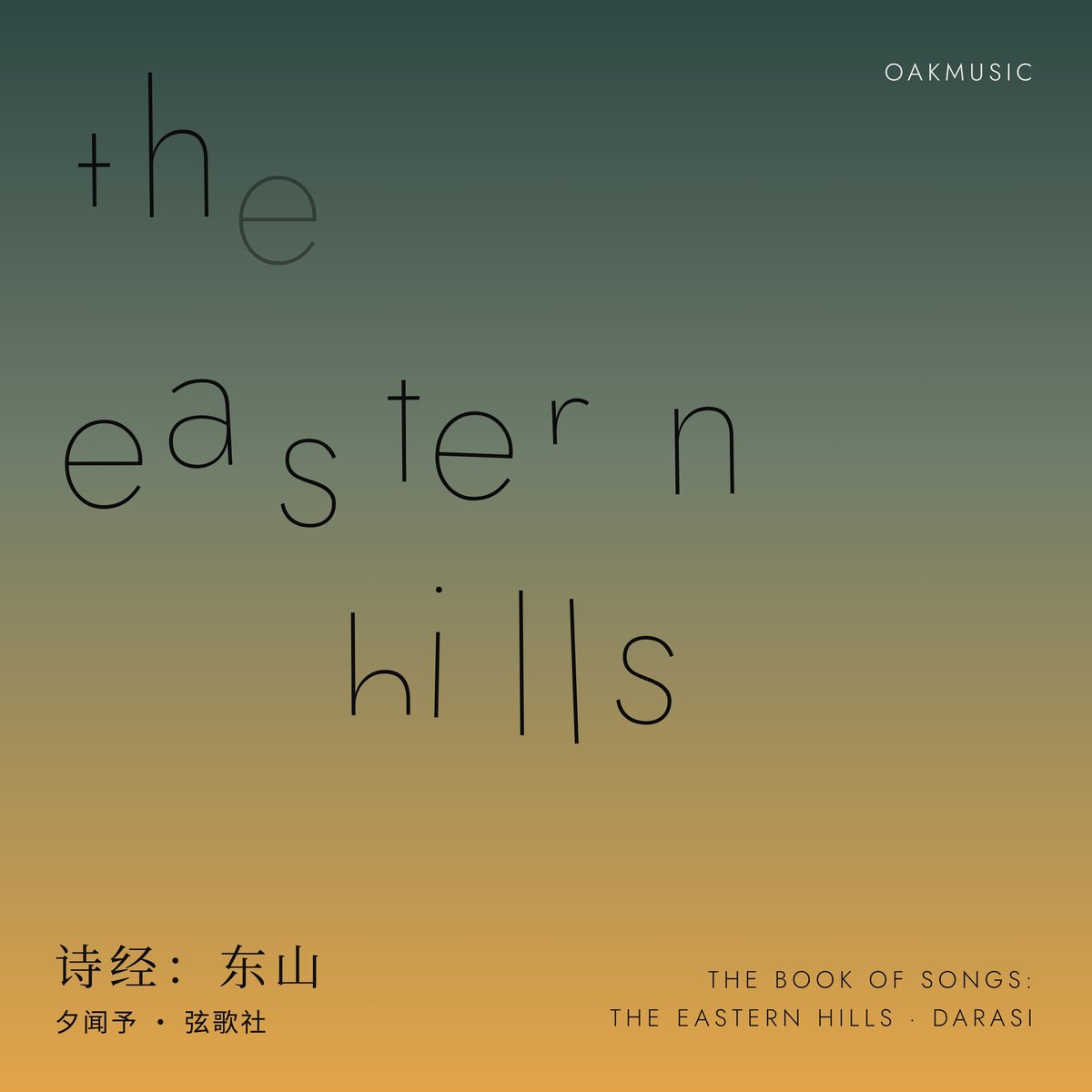
诗经:东山The Book of Songs: The Eastern Hills
夕闻予 沅有芷Darasi · Oaknis
收听Listen
曲目Tracks
点开每首,看原诗全文、白话、英译与歌词。Tap a track for the full ancient poem, a modern Chinese version, the English translation and the lyrics.
- 春 · 舞Spring · dance
- 01 鹿鸣 The Deer Cry 《小雅·鹿鸣》 · 夕闻予Minor Odes of the Kingdom · Darasi 宴宾之歌,「呦呦鹿鸣,食野之苹」。笙奏古谱开场。A song for welcoming guests: "With pleased sounds the deer call to one another, / Eating the celery of the fields." A mouth organ opens with the old score. 3:05
- 02 采蘩 Gathering White Mugwort 《召南·采蘩》 · 夕闻予Odes of Shao and the South · Darasi 采白蒿以供祭祀。琵琶把古谱的一小段做成循环。Gathering mugwort for the sacrifice; a phrase of the old score loops on pipa. 3:50
- 03 溱洧 Zhen and Wei 《郑风·溱洧》 · 夕闻予、沅有芷Odes of Zheng · Darasi, Oaknis 春水边,青年男女相约同游,两人对唱。By the rivers in spring, young men and women meet, and answer each other in song. 3:41
- 夏 · 歌Summer · song
- 04 摽有梅 Plums Are Falling 《召南·摽有梅》 · 夕闻予Odes of Shao and the South · Darasi 梅子纷纷落下,催人及时开口;有两段改用今天的话来唱。The plums are falling: speak while there is time. Two passages are sung in modern Chinese. 3:09
- 05 月出 The Moon Comes Out 《陈风·月出》 · 夕闻予Odes of Chen · Darasi 月下见一人,心神不宁。旋律新写。Someone seen by moonlight, and a heart that will not settle. A new melody. 4:39
- 夏秋之交Summer into autumn
- 06 七月 The Seventh Month 《豳风·七月》 · 夕闻予、沅有芷Odes of Bin · Darasi, Oaknis 一年的农事。人声照元代古谱,一字一音唱完八章。A farming year. All eight stanzas are sung to a Yuan-dynasty score, one note per character. 12:39
- 秋 · 弦Autumn · strings
- 07 燕燕 Swallows 《邶风·燕燕》 · 夕闻予Odes of Bei · Darasi 送别,「瞻望弗及,泣涕如雨」。小提琴用清宫谱首句作前奏。A farewell: "I looked till I could no longer see her, / And my tears fell down like rain." A violin opens with the first line of the Qing court score. 4:11
- 08 黍离 The Millet Droops 《王风·黍离》 · 夕闻予Odes of the Royal Domain · Darasi 故都长满黍稷,「知我者谓我心忧」。古谱只交给小提琴。Millet growing over the old capital: "Those who knew me / Said I was sad at heart." The old melody is played on violin alone. 5:10
- 09 东山 The Eastern Hills 《豳风·东山》 · 沅有芷Odes of Bin · Oaknis 征人别家三年,归来路上想着家。沅有芷演唱。A soldier three years from home, on the road back. Sung by Oaknis. 4:55
- 冬 · 诵Winter · recitation
- 10 大东 The Great East 《小雅·大东》 · 夕闻予Minor Odes of the Kingdom · Darasi 东方诸国困于赋役,「小东大东,杼柚其空」。The eastern states, exhausted by taxes and labour: "In the States of the east, large and small, / The looms are empty." 4:46
- 11 葛生 The Creeper Grows 《唐风·葛生》 · 夕闻予Odes of Tang · Darasi 悼亡,「百岁之后,归于其居」。A lament for the dead: "Till the lapse of a hundred years, / When I shall go home to his abode." 3:59
- 12 伐木 Felling Trees 《小雅·伐木》 · 夕闻予、沅有芷Minor Odes of the Kingdom · Darasi, Oaknis 「嘤其鸣矣,求其友声」。原诗段落照清宫谱唱,乐队合奏,全辑终曲。A bird calls from the trees, "Seeking with its voice its companion." The ancient verses are sung to the Qing court score, with full orchestra, to close the album. 9:09
专辑介绍About the album
一 两三千年前
两三千年前的夜晚,曾有人在月光下望向另一个人,望得心神俱乱;曾有人立在梅树下,趁枝头青梅落尽之前,催促心上人早些开口;曾有人熬过三年征戍,踏上泥泞的归途,却不知推开家门时,屋里是否还有人守候;也曾有人挨过漫长的夏日与凛冽的冬夜,对着逝者的荒冢轻声许诺:待百年之后,我便去你那里同住。
岁月流徙,人心却未曾改易。这些隐秘的震颤今天仍在发生,只是我们在喧嚣里走得太急,很少停下来细听。这十二首歌,便是停下脚步、侧耳倾听的产物。
二 一年,十二首
《诗经》本是泥土与旷野里长出来的歌。做这张专辑时,我们总想把它们送回最初的田野:同一片大地上,几千年后的人依然在春耕秋收、相爱送别、背井离乡、默然守望;人们依然在唱那些古老的歌谣,只是换了今日的乡音,改了此刻的腔调。
《墨子·公孟》载儒者「诵诗三百,弦诗三百,歌诗三百,舞诗三百」。我们借这四个字为经纬,将十二首歌排布成一整个流转的岁时:
- 春之「舞」:鼓点落得最实,人声最众,满是破土而出的生机。
- 夏之「歌」:旋律最为舒展动听,如盛夏草木般恣意生长。
- 秋之「弦」:小提琴吃重,弓弦擦过之处,尽是西风渐起的凉意。
- 冬之「诵」:人声收束得最紧、最克制,万籁敛藏,直至终曲《伐木》响起,整支乐队才轰然苏醒。
《七月》坐落于专辑正中,恰是夏秋交替的枢纽——「七月流火」,大火星向西天沉落,暑气消退,寒意初生。而收尾的《伐木》唱着「嘤其鸣矣,求其友声」,则是留给一路听到最后的人的一声回响。
三 原诗为骨,今声为应
每一首歌,皆以先秦原诗立骨;我们另外动笔写下的现代词句,则名曰「今声」。今声并非原诗的白话翻译,而是一场隔着漫长时光的应答:原诗发问,今声作答。原诗留在古远的田野,今声则落向今日的楼宇、街巷与灯火下的凡人。
至于原诗入歌的分量,全凭每首作品的气息逐一定夺。《七月》八章一字未改,全篇皆唱原诗,不着一句今声;《伐木》保留了大半原诗,肌理间穿插三段今声;《摽有梅》的古语入耳过于生僻,我们索性将其中的两段直接化作了今天的日常口吻。
四 古曲从哪里来
《诗经》的先秦原曲早已湮没于历史烟尘。我们在案头摊开并取用的,是后世传录或拟作的两份古乐谱。
一份是元代熊朋来的《瑟谱》,底本取自《四库全书》文溯阁抄本的影印件。其中卷二「诗旧谱」收录南宋赵彦肃所传十二篇,相传为唐代开元年间遗存的旧谱;卷三与卷四「诗新谱」则是熊朋来亲手配定的新作,凡二十篇,《黍离》《七月》皆在其中。另一份是清代乾隆年间的《钦定诗经乐谱全书》,底本用的是武英殿活字本扫描件,全书三十卷,洋洋洒洒为三百零五篇《诗》悉数配齐了乐谱。
这些古谱皆依「一字一音」之制,字下系音,却不标轻重缓急的节奏。我们在编曲时完整保留了所取谱段的音高次序,至于律动的呼吸与器乐的编配,则完全由现代制作手段重新赋予。它们并非先秦时代的原调,而是宋元文人与清代宫廷为礼乐重塑的声腔——这一点,我们坦诚相告。十二首作品对古谱的取舍与化用,各自不同:
- 《鹿鸣》:取《瑟谱》诗旧谱首章前四句,以笙吹奏作引,人声旋律顺着古谱的尾音自然生长。
- 《采蘩》:截取《瑟谱》诗旧谱首章的一小段,交由琵琶弹拨,化作贯穿全曲的循环律动。
- 《七月》:依《瑟谱》诗新谱,由人声一字一音,完整唱尽八章。
- 《燕燕》:取《钦定诗经乐谱全书》首句,化作小提琴孤清的前奏。
- 《黍离》:采用《瑟谱》诗新谱,全段仅交由小提琴倾诉,不入人声。
- 《大东》:撷取《钦定诗经乐谱全书》「小东大东,杼柚其空」一句,由小提琴奏出前奏。
- 《葛生》:抽取《钦定诗经乐谱全书》里「与、独、处」三字之音,凝成钢琴上寥落的短句。
- 《伐木》:原诗依《钦定诗经乐谱全书》清宫谱演唱,由现代乐队在声场深处稳稳承托。
- 《溱洧》《摽有梅》《月出》《东山》:不依古谱,旋律皆为全新谱写。
五 关于唱法的争论
专辑里,《七月》照古谱一字一音唱完八章,《伐木》的原诗亦严格依清宫谱行腔。曾有听众提出质疑:字字等长,古曲怎能如此呆板地唱?其实,这场争论早在八百年前便已展开。
怀疑「一字一音」者不在少数。朱熹便认为古人唱诗理当「有唱有叹」,伴以应和、叠字与散声,他在《仪礼经传通解》卷十四中写道:「诗词之外,应更有叠字、散声,以叹发其趣。」清代学者李塨在《小学稽业》里言辞更为激烈,直言这种字字等长、毫无高低疾徐之变的歌,「从古未有」。而坚持「一字一音」者亦自有其法度:元人熊朋来为《七月》配谱便是字音相随;乾隆更是有意矫枉,勒令将宫中雅乐改回「一字各还一音」,痛批那种一字拖曳数音的唱法是「援雅正而入于繁靡」。
我们也曾试着走过另一条路:特意为《七月》制作了一版「新篇」,在句读间添入应和与叹咏。然而几经易稿、反复试过,那些修饰丰满的版本,终究不及照谱直唱的那一版动人。最终留下的这一字一音,听见的是一份近乎粗粝的庄重——仿佛在极遥远的地方,有一个人正守着岁月的刻痕,一字一顿地数着月份。这或许不是古人唱《诗》唯一的模样,却是今天我们循着纸上遗谱,依然能够确切找回来的一种声音。
其余十首歌,人声皆未拘泥于古谱:六首(《鹿鸣》《采蘩》《燕燕》《黍离》《大东》《葛生》)将古谱隐入器乐的肌理,四首(《溱洧》《摽有梅》《月出》《东山》)则全然生长出新的旋律。人声采用当代流行音乐的语汇,以坦荡的真声为主,极少修饰虚浮的气声。这是属于今天的唱法,而非考古式的复原。
六 两位歌手
专辑中的两位歌者皆为虚拟歌手,在现实世界里不对应任何具象的真人。
主唱名唤「夕闻予」,十二首歌里由她担纲了十一首。其名化自《楚辞·九歌·湘夫人》:「闻」「予」取自「闻佳人兮召予」,「夕」取自「与佳期兮夕张」。「闻」,即听见。《汉书》记载,古有采诗之官摇着木铎沿途巡行,将散落民间的悲欢歌谣一一收拢;赋予她这个名字,便是愿她做那个执铎倾听的人,把千年前听见的声息,重新唱给今天的人听。
男声名唤「沅有芷」,在专辑中献声于《溱洧》的男女对答、《七月》的第五章、《东山》的沧桑征人,以及《伐木》的第二段与尾声。他的名字同样出自《湘夫人》:「沅有芷兮澧有兰,思公子兮未敢言。」他亦将作为下一张以「问」为总纲的专辑《楚辞:问渡》的主唱继续前行。
一个侧耳听见,一个开口发问,两个名字自同一首《湘夫人》中分途走来,恰成回响。
七 怎么读这一页
倘若面对古奥的原诗一时难以尽解,也全无妨碍。在这一页的编排里,每一首歌都将四重文本并置呈现:先秦原诗全文、我们亲手译写的现代白话、理雅各(James Legge)于 1871 年完成的经典英译,以及中英对照的「今声」歌词(唯《七月》全篇唱诵原诗,不设今声;《摽有梅》则有两段径直化用了今日的白话入歌)。
你大可以先闭目听歌,再展卷细读;亦不妨先在字句间读懂古人的心事,再按下播放键,听听几千年后的今声,如何向它作答。
I. Two or Three Thousand Years Ago
On some night two or three thousand years ago, someone gazed at another in the moonlight until their heart came undone. Someone stood beneath a plum tree, urging the one they loved to speak before the last fruit fell from the branch. Someone survived three years of war and trudged down a muddy road toward home, uncertain whether anyone still waited behind the door. And someone endured the long glare of summer days and the bitter dark of winter nights, standing beside a grave to make a quiet vow: after a hundred years, I will come and share your dwelling.
Centuries pass; the human heart remains what it was. These quiet tremors still happen every day—we simply move too fast, through too much noise, to pause and hear them. These twelve songs are what came of stopping to listen.
II. One Year, Twelve Songs
The Book of Songs (Shijing) grew straight out of dark soil and open country. Throughout the making of this album, we kept wanting to carry these songs back to the fields that bore them: upon that same earth, millennia later, people still plough in spring and reap in autumn, fall in love and part ways, leave home and keep watch. They are still singing those ancient songs—only in today's accents, to today's tunes.
The "Gong Meng" chapter of the Mozi records that early Confucians "recited the three hundred odes, played the three hundred odes on strings, sang the three hundred odes, and danced the three hundred odes." Taking those four modes—recitation, strings, song, and dance—as warp and weft, we laid the twelve tracks out across the arc of a single turning year:
- Spring is dance: The drums strike hardest and the voices gather in force, thrumming with life breaking through the soil.
- Summer is song: The melodies unfold at their freest, luxuriant as midsummer grass.
- Autumn is strings: The violin bears the weight, every draw of the bow carrying the chill of a rising west wind.
- Winter is recitation: The voice is held at its tautest and most restrained, all things hushed and gathered inward—until the closing track, "Felling Trees," when the entire band awakens at once.
"The Seventh Month" sits at the album's center, right at the hinge between summer and autumn: "In the seventh month, the Fire Star passes the meridian"—Antares sinking westward as the heat ebbs and the first cold stirs. And "Felling Trees," which brings the record to a close, sings of a bird calling from the woods—"While ying goes its cry, / Seeking with its voice its companion"—an answering call left for whoever has listened all the way to the end.
III. The Ancient Poem as Bone, the New Verse as Answer
Every track takes a pre-Qin poem as its spine. Alongside the ancient text, we wrote modern lyrics we call jinsheng—literally, "the voice of now." Jinsheng is not a modern translation of the original verse; it is a reply sent back across a vast expanse of time. The ancient poem asks; the modern voice answers. Where the old verses remain in distant fields, jinsheng steps out among today's towers and streets, and the ordinary lives unfolding beneath their lights.
How much of the ancient text enters each track was decided song by song, guided by the breath of the piece itself. "The Seventh Month" sings all eight stanzas intact, without a single line of jinsheng. "Felling Trees" preserves the bulk of the original ode while threading three modern passages through its grain. In "Plums Are Falling," the archaic phrasing proved too opaque for the ear alone, so we rendered two passages of the ancient poem directly into everyday modern Chinese.
IV. Where the Old Melodies Come From
The original pre-Qin melodies of the Book of Songs vanished into history long ago. Spread across our desk were two surviving collections of later musical settings—some handed down by tradition, others newly composed in imperial times.
The first is the Se Pu (Scores for the Se Zither) by Xiong Penglai of the Yuan dynasty, consulted in a facsimile of the Wensu Pavilion Siku Quanshu manuscript. Its second volume, "Old Scores for the Odes," preserves twelve settings transmitted by Zhao Yansu of the Southern Song, reputedly surviving from the Kaiyuan era of the Tang; its third and fourth volumes, "New Scores," contain twenty settings composed by Xiong himself, including "The Millet Droops" and "The Seventh Month." The second source is the Qinding Shijing Yuepu Quanshu (Imperially Commissioned Complete Scores of the Book of Songs) from the Qianlong reign of the Qing dynasty, consulted via scans of the Wuying Palace movable-type edition, which sets all 305 odes across thirty volumes.
Every piece in these collections is strictly syllabic: a single pitch is written beneath each character, with no notation for rhythm, stress, or tempo. In our arrangements, we preserved the exact pitch sequence of every excerpt we borrowed, while breathing fresh rhythmic pulse and modern instrumentation into the bare notes. These are not the lost melodies of high antiquity; they are ritual settings reimagined by Song and Yuan literati and by the Qing court, and we state that plainly. Each of the twelve tracks engages with the historical scores in its own way:
- "The Deer Cry": The opening four lines from the Se Pu Old Scores, breathed through a sheng mouth organ as prelude, with the vocal melody growing organically out of its final notes.
- "Gathering White Mugwort": A brief motif from the Se Pu Old Scores, handed to the pipa as a looping pulse that threads through the entire piece.
- "The Seventh Month": Following the Se Pu New Scores, the voice sings all eight stanzas straight through, one note per character.
- "Swallows": The opening line from the Qing court score, recast as a solitary violin prelude.
- "The Millet Droops": Taken from the Se Pu New Scores and entrusted entirely to solo violin, without vocals.
- "The Great East": The Qing court setting for "In the States of the east, large and small, / The looms are empty," voiced by the violin as prelude.
- "The Creeper Grows": Three lone pitches from the Qing court score—for yu (with), du (alone), and chu (dwell)—distilled into a sparse piano figure.
- "Felling Trees": The ancient verses sung faithfully to the Qing court melody, buoyed deep in the soundstage by a modern ensemble.
- "Zhen and Wei," "Plums Are Falling," "The Moon Comes Out," "The Eastern Hills": Unbound by historical notation, set to entirely new melodies.
V. The Debate Over How to Sing
On this record, "The Seventh Month" is sung across all eight stanzas straight from the historical score, one note to a word, and the ancient verses of "Felling Trees" hew just as strictly to the Qing court notation. Early on, a listener objected: Every syllable is the same length—how could an ancient song be sung so stiffly? As it happens, that very quarrel began eight hundred years ago.
Skeptics of syllabic singing have long made their case. The Song philosopher Zhu Xi maintained that ancient performance must have combined "singing and sighing," enriched by vocal responses, refrains, and wordless vocables; in the fourteenth volume of his Yili Jingzhuan Tongjie, he wrote that "beyond the words of the poem, there must have been repeated syllables and scattered sounds to draw out its spirit through sighs." The Qing scholar Li Gong, writing in Xiaoxue Jiye, was blunter still: a song in which every word is of equal length, devoid of rise and fall or quickening and slowing, "has never existed since antiquity." Yet proponents of one note per character stood on principled ground of their own. Xiong Penglai set "The Seventh Month" syllabically in the Yuan dynasty, and the Qianlong Emperor deliberately sought to reform court music by ordering that "each character be restored to a single note," condemning melismatic settings that stretched one word across several pitches for "dragging poised elegance down into florid indulgence."
We explored that other road ourselves. We built an alternate arrangement of "The Seventh Month," weaving vocal responses and sighed cadences between the phrases. Yet through draft after draft and attempt after attempt, none of those fuller, more ornate versions moved us the way the unadorned score did. What remains on the album—strictly one note per character—carries an almost weathered solemnity, as though someone very far away were keeping tally by the notches of the years, counting out the months word by word. It may not be the only way antiquity sang the Odes, but it is one genuine resonance we can still recover from the page today.
Across the remaining ten tracks, the vocals slip free of the old scores: six weave the historical notation into the instrumental fabric ("The Deer Cry," "Gathering White Mugwort," "Swallows," "The Millet Droops," "The Great East," "The Creeper Grows"), while four are newly composed from the ground up ("Zhen and Wei," "Plums Are Falling," "The Moon Comes Out," "The Eastern Hills"). The singing speaks the language of contemporary pop—grounded in an open, unvarnished chest voice with minimal breathiness. It is a way of singing meant for the living present, not an exercise in musical archaeology.
VI. The Two Singers
Both vocalists on this album are virtual singers, corresponding to no real-world persona.
Our lead vocalist is Darasi—known in Chinese as Xiwenyu (夕闻予)—who carries eleven of the twelve tracks. Her name is drawn from "The Lady of the Xiang" in the Nine Songs of the Chuci (Songs of Chu): wen and yu from wen jiaren xi zhao yu ("I hear my beloved calling me"), and xi from yu jiaqi xi xi zhang ("for our promised tryst I make ready at dusk"). Wen (闻) means to hear. The Book of Han tells of ancient envoys who walked the roads shaking wooden-tongued bells to gather songs of joy and sorrow from the common folk. We named her in the hope that she might be the one holding that bell—listening across millennia, and singing what she heard back to the living.
The male voice belongs to Oaknis, or Yuanyouzhi (沅有芷). He steps in for the lovers' dialogue in "Zhen and Wei," the fifth stanza of "The Seventh Month," the weathered soldier of "The Eastern Hills," and the second movement and coda of "Felling Trees." His name stems from the same poem: Yuan you zhi xi Li you lan, si gongzi xi wei gan yan ("Angelica grows by the Yuan, orchids by the Li; I long for my lord, yet dare not speak"). From here, he journeys onward as the lead vocalist of our next album, Chuci: Wendu (Songs of Chu: Asking at the Crossing), which takes another wen (问)—to ask—as its compass.
One listens; the other asks. Setting out from the same ancient poem, their two names answer each other across the dark.
VII. How to Read This Page
If the archaic Chinese seems daunting at first glance, let it be no barrier. For every track on this page, four texts are laid out side by side: the complete pre-Qin poem; our own rendering into modern vernacular Chinese; James Legge's classic English translation of 1871; and the bilingual jinsheng lyrics. ("The Seventh Month" is sung wholly in the ancient text without jinsheng, while two passages of "Plums Are Falling" are sung directly in modern vernacular.)
You might close your eyes and listen first, turning to the page afterward; or read the poems first to find the pulse of those ancient hearts among the lines, and then press play—to hear how a voice thousands of years later answers them back.
制作信息Credits
弦歌社 OakMusic 出品
演唱 夕闻予(Darasi)、沅有芷(Oaknis)
词曲 Léonard Oaks Cheung(部分曲目唱原诗)
原诗 《诗经》
古谱 元·熊朋来《瑟谱》;清·《钦定诗经乐谱全书》
原诗英译 James Legge, The She King (1871)
古籍书影 《毛诗》,清乾隆四十八年武英殿仿宋相台本,哈佛燕京图书馆藏
℗ © 2026 弦歌社 OakMusic
Produced by OakMusic (弦歌社)
Vocals: Darasi, Oaknis
Words and music: Léonard Oaks Cheung (some tracks are sung to the ancient text)
Ancient poems: the Book of Songs (Shijing)
Ancient scores: Xiong Penglai, Se Pu (Yuan dynasty); Qinding Shijing Yuepu Quanshu (Qing dynasty)
English translations of the Odes: James Legge, The She King (1871)
Facsimile pages: Mao shi, Wuying Palace edition after the Song Xiangtai text (1783), Harvard-Yenching Library, Harvard University
℗ © 2026 OakMusic (弦歌社)